In the past few months, we have witnessed several
changes owing to the pandemic. We face restrictions
in our everyday lives and due to the rising number
of COVID-19 cases, the pressure on the health
systems is more than ever.
Compromised Abortion Access due to COVID-19: An Ipas Development
Foundation Report
Ipas Development Foundation’s (IDF) report on ‘Compromised Abortion
Access due to COVID-19’ finds that access to an estimated 1.85
million abortions have been compromised during the lockdown period.
Since the dynamic changes in lockdown restrictions impact the degree
of compromise of abortion access, IDF considered four distinct time
periods for estimation and expected that abortion access will be
impacted across all points of care.
The study implies, an estimated 1.85 million women will be unable to
access abortion services as a near-term impact of COVID-19, directly
affecting their sexual and reproductive health. It is expected that
the compromised access results in five possible scenarios:
Women are able to access abortion, albeit a little delayed, but
in their preferred point of care
Women are able to access abortion, but not as per their initial
preference – while MA outside the facility is the preferred
method for majority of women, delayed access may result in
exceeding the permissible limit of nine weeks and they may have
no choice other than facility-based surgical abortion.
More women have requirement for second trimester abortions
(beyond 12 weeks)
Women continue their unintended pregnancy
Women resort to unsafe abortions
This situation places additional responsibilities on the health
system to offer remedial options to these women - both during and
post the recovery period.
Impact of COVID-19 on India’s Family Planning Program - A Foundation
For Reproductive Health Services India Policy Brief
One of the many problems faced by the people in India, since the
lockdown started in March 2020, is limited access to safe abortion
and family planning services. With around 27.18 million couples
estimated to be left with no access to or use of contraceptives,
FRHS India estimates that this situation will lead to around 2.95
million unintended pregnancies, 844,483 childbirths and 2,165
maternal deaths by the end of 2020.
#ItsTimeWeHelp #DoctorsAsPartners- A Pratigya Campaign Initiative
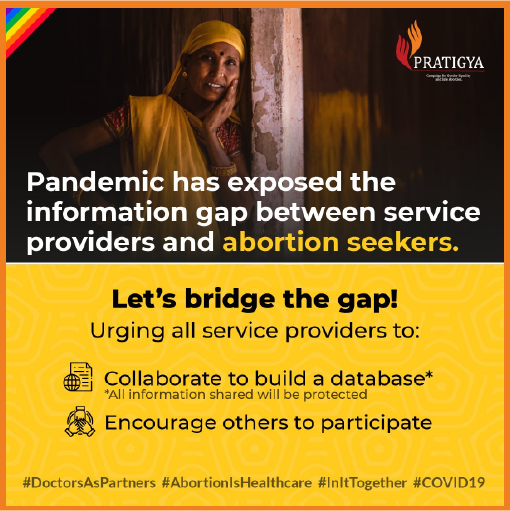
Staying true to our goal of enabling wider access for effective
reproductive care, this month the Campaign set out to build a
systematic database by crowdsourcing information on MTP providers in
the country.
This crowdsourced database will be published on Pratigya Campaign’s
website and anyone seeking safe abortion services and post abortion
family planning will be able to access the information.
Pratigya Campaign will respect confidentiality of the providers and
information seekers alike and will have checks in place to ensure no
misuse of the data.
Your help is sought to make this initiative a success.
Share the form with your friends, family and network and help us
build this database.
Pass on the form to your friends and family members
*All information shared will be protected by the Pratigya Campaign
Secretariat
So, join us in creating this channel of support and help in tackling
the challenges facing SRH services in India in these tumultuous
times.
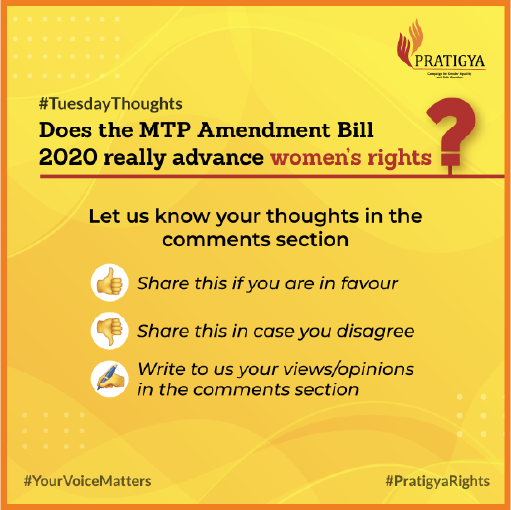
Advocating with larger civil society organisations:
A larger civil society coalition of 30+ members including Pratigya
Campaign coalition is working on important recommendations in
certain sections of the proposed MTP Amendment Bill 2020 that would
move the law towards a more empowering approach for improving the
agency and access of pregnant persons.
The coalition comprises experts from civil society groups, former
ministry officials, medical providers, media, judiciary, service
providing organisations and other civil society coalitions like
Common Health, JSA, ISAY, ASAP and MASUM.
The larger coalition is working on both offline and online media to
affect change, and advocate with bureaucrats and policy makers.
A second phase of the Availability of Medical Abortion drugs study
has been conducted across Assam, Delhi, Haryana, Madhya Pradesh,
Punjab and Tamil Nadu. The team has surveyed, collected data and is
currently finalising the report. Initial findings suggest that there
is negligible to no availability of MA drugs in Tamil Nadu, Haryana,
Punjab and Madhya Pradesh.
Watch this space for more
Real Stories of Endurance
Meet Reena (name changed), a client who wanted to avail an emergency
abortion service in Bareilly during the lockdown. A mother of five,
due to her poor socio-economic conditions, she realised she would
not be able to raise another. She had heard about FRHS India from
her sister who had earlier received treatment from one of the
clinics.
What followed next was an arduous journey of 45 kms on a two-wheeler
for Reena and her husband to reach the nearest clinic, in a time
when many FP clinics in India were ordered to stop their operations.
On her way, she was stopped every few minutes by police to whom she
had to explain her predicament and be let through. However, one of
the Asha workers and a staff from the FRHSI clinic were constantly
in touch with her over the phone and were ready to talk to the
police whenever needed. On reaching the clinic, she was offered
proper counseling and successfully availed Safe Abortion and Post
Abortion Family Planning services.
This month we dedicated our social media space to celebrating Pride
month and we ran a campaign to crowdsource MTP providers information
to bridge the information gap.